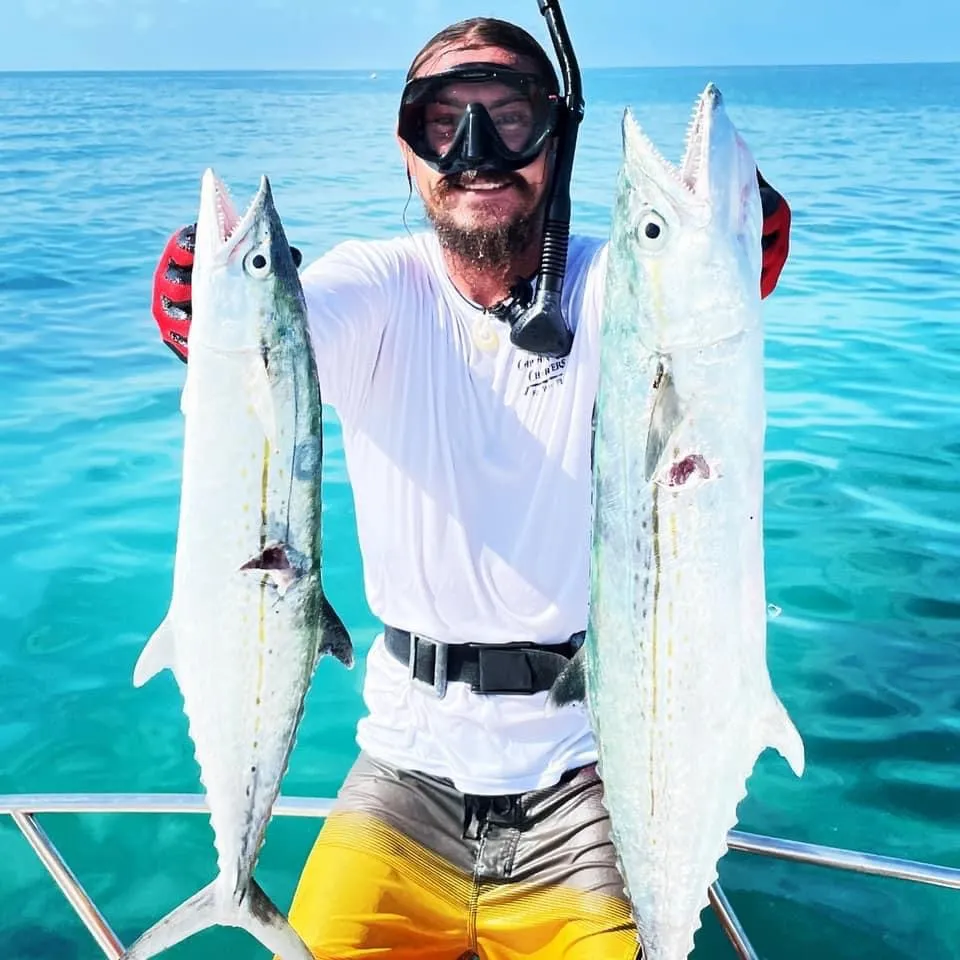
You do not need a scuba certification to go spearfishing in Key West, and you do not need to have done it before. Trips with Captain Rio’s Charters are freediving — breath-hold, no tanks — and if you’re comfortable snorkelling in shallow water, you already have the only prerequisite that matters. Everything else gets taught on the boat.
That surprises people. Spearfishing has a reputation for being the preserve of very serious divers, and there’s a version of it that is. But the version most first-timers do is closer to snorkelling with a purpose: shallow water, good visibility, one breath at a time.
What “freediving” actually means here
No tanks, no certification, no equipment you have to own. You take a breath at the surface, swim down, and come back up. Most of the productive ground around Key West is shallow enough that a single comfortable breath is plenty — you are not being asked to push depth or hold your breath to any limit.
The upside of freediving over scuba for this, beyond the lack of paperwork, is that you’re quiet. No exhaust bubbles, no noise. Fish that would leave the moment a scuba diver arrived will often sit still for a freediver.
What a first trip looks like
Rio starts beginners in shallow, calm water — not on a wreck in current. Before anyone goes near a fish, he covers four things:
Breathing. How to breathe up before a dive and, more importantly, what not to do. Over-breathing before a breath-hold is the single most dangerous mistake a new freediver can make.
Equalising. Clearing your ears on the way down. This is the thing that stops most beginners, and it’s a technique problem rather than a fitness one — it’s learnable in minutes.
Safety protocol. One diver down, one on the surface watching, every time. Nobody dives alone. Shallow water blackout is the real risk in freediving, it gives very little warning, and the only reliable defence is a buddy whose actual job is watching you. This is not negotiable and it is not a formality.
Shot placement. Where to aim, when not to take the shot, and how to handle the fish once it’s on the spear.
Then you get in the water and try it. Most people are landing fish on their first trip.
What you’re hunting
Depending on season and depth, the targets around Key West are grouper, snapper, hogfish, amberjack — and lionfish.
Lionfish deserve a mention of their own. They’re an invasive species with no natural predators in these waters, they eat their way through juvenile reef fish, and every one taken off the reef is a straightforward good deed. They’re also slow, which makes them a forgiving first target, and genuinely excellent eating. Their spines are venomous, so handling is a technique Rio will show you rather than something to work out yourself.
Hogfish are the ones people get obsessed with. They’re wary, they’re a proper stalk, and they are arguably the best-eating fish in the Keys.
The gear
Included on the trip: snorkel and dive equipment, and the spearfishing gear itself. You don’t need to buy anything to try this.
Bring your own mask and fins if you have a set you already love — mask fit is personal, and a mask that leaks will ruin a day faster than anything else. Otherwise, reef-safe sunscreen, a towel, a change of clothes, and something to eat and drink.
Why local knowledge is the whole game
Spearfishing is different from rod-and-reel fishing in one important way: you cannot cover water. You’re swimming. If you’re in the wrong place, you don’t get a slow day — you get nothing at all.
Which means the entire trip rests on someone knowing which ledge is holding hogfish this month, which wreck the amberjack are stacked on, and how hard the tide has to be running before it’s even worth getting in. Rio has been hunting these reefs and wrecks since he was a kid and competes at it. That’s not a marketing line; it’s the actual product you’re buying.
It’s also why these trips are 100% private. Spearfishing needs the boat working around one group’s pace, dive by dive — moving when the spot isn’t producing, waiting when it is. That doesn’t work on a shared schedule.
The rules
Spearfishing in the Florida Keys is legal in permitted areas and for permitted species, and there are meaningful restrictions on where you can do it — protected zones and sanctuary areas where it isn’t allowed at all — as well as size limits, bag limits and closed seasons that vary by species and time of year.
Rio only fishes legal ground, the vessel’s license covers guests aboard so you don’t need your own, and he handles the measuring and the limits so it isn’t something you have to research. If you want to check the current regulations yourself, the Florida Fish and Wildlife Conservation Commission publishes them.
Is it for you?
Yes, if you can snorkel comfortably, you’re reasonably fit, and the idea of catching dinner by hand appeals more than sitting behind a rod.
Probably not, if you’re not confident in open water, or you have ear problems that make equalising painful. Say so when you book rather than finding out at the ledge — Rio will steer you toward a snorkelling or fishing trip instead, and you’ll have a better day.
Kids and nervous first-timers are fine on the snorkelling side of the trip even if they don’t want to hunt. The boat can do both.
Rates
A half day (4 hours) is $900 and a full day (8 hours) is $1,700 — flat rates for up to six guests, not per person. Fuel is billed on top: consumption is tracked on every trip and you’re responsible for what your charter uses. Gratuity isn’t included.
Want to try it? Call or text Captain Rio on 305-394-1278. Tell him your experience level honestly — complete beginner is a perfectly good answer, and it changes where he takes you rather than whether he’ll take you.